


Core drilling
Frequently ordered types of core drilling in Bergen and the surrounding area
Diamond core drilling in reinforced concrete, Leca and bricks is an effective method of making holes for pipes, ventilation or cables, but in private homes it requires careful planning to avoid damage to the building structure and infrastructure.
Before starting, we must know exactly:
1. Locating pipes and cables with the help of a professional concrete scanner or search equipment – where the reinforcing bars, power cables, water pipes and heating pipes (underfloor heating) are located to avoid consequences:
- Hitting a live cable is fatal.
- Hitting water pipes can cause major water damage.
2. Structure and load-bearing capacity
- Core drilling must be planned in load-bearing walls and floors to avoid weakening the structure.
- Core drilling cuts reinforcing bars, so the extent must be considered.
3. Availability of water and electricity
- Wet drilling requires water for cooling the diamond drill and dust binding. This creates slurry (concrete sludge) that must be handled.
- Use a wet/dry vacuum cleaner to continuously collect the slurry.
- Dry drilling can be used with good dust extraction in some cases to avoid fine silica dust in the home.
- Protect floors, walls and furniture nearby because concrete slurry is very difficult to remove when it dries.
4. Safety and working environment
- Notify neighbors if it is a residential unit/townhouse, as core drilling is very noisy.
- Use personal protective equipment (PPE): safety glasses, hearing protection, mask (dust protection) and gloves.
- The drilling machine must be anchored firmly to the wall/floor to avoid accidents, especially with large diameters.
- Always use a GFCI/Ground Fault Circuit Interrupter when wet drilling, as water and electricity are a dangerous combination.
5. Planning the implementation
- Choose the correct drill diameter.
- Consider how the concrete cylinder (core) will be removed after drilling, especially in thick walls (over 500mm).
- Oblique drilling is considered: Should the hole have a slope to prevent water ingress?
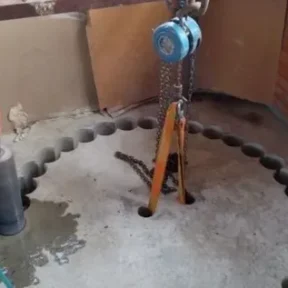
Core drilling is performed in a round shape (cylindrical shape)
It is the most efficient, precise and structurally gentle method of making holes in hard materials such as concrete, stone and asphalt.
Main advantages of using round core drilling:
Can drill through rebar: The diamond segments cut through both concrete and steel.
Quiet and dust-free: The use of water cooling (wet drilling) minimizes dust, and the method is ideal for rehabilitation in inhabited buildings.
Flexibility: Can be used vertically, horizontally and at angles.
Here are the main reasons why core drilling is round:
- optimal strength and structural integrity
- precision and accuracy
- minimal vibration and noise
- efficient material removal
- adaptation to infrastructure
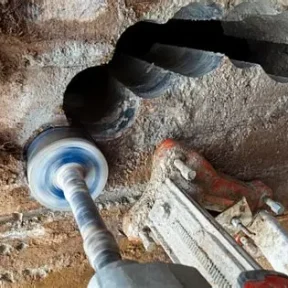
Diamond core drilling in rock
Diamond core drilling in rock is primarily used because it is the most efficient and precise method of penetrating very hard rocks, while achieving high precision. Since diamond is the hardest material we have, diamond drills are ideal for hard rock (such as granite) and concrete.
Here are the main reasons why diamond core drilling in rock is used:
- Minimal environmental damage
- Noise and vibration reduction
- Drilling deep holes for foundations, anchor bolts, cable and pipe penetrations
- Used for silent rock removal or precise splitting of stone blocks
- In quarry production, diamond core drilling can halve the scrap rate, which makes better use of resources
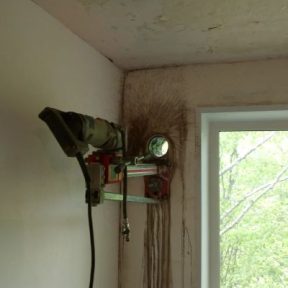
Kjerneboring hull til ventilasjon i betongkonstruksjoner
By drilling ventilation holes (or installing valves in windows), you ensure a controlled exchange of air.
Important tips about valves:
Leave them open: According to Sintef Byggforsk, valves should be left open all year round, even in winter, to avoid soot and poor indoor climate.
Do not turn off the system: If you have a mechanical ventilation system, this must never be turned off completely, as it can lead to moisture problems.
Here are the main reasons why vents are drilled in walls, foundations or windows:
- removes moisture and prevents mold/fungus
- improves indoor climate and health
- in basements and crawl spaces, ventilation is especially important to remove moisture from the foundation
- modern homes are very airtight to save energy, but this requires an active supply of fresh air to avoid "trapped" air
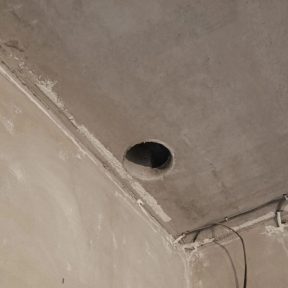
Core drilling in concrete structure ceilings
The method is used when regular impact drills are not powerful enough, or when vibrations and dust that can damage the structure must be avoided.
The most common reasons for core drilling in ceilings are:
- used to create penetrations for water pipes, drains, ventilation ducts and air conditioning
- to pull thick power cables or cable trays through concrete floor dividers
- for installing sprinkler heads in the ceiling
- unlike studding, core drilling causes very little vibration, which preserves the structural integrity of the concrete
- can be performed vertically, horizontally or at an angle (oblique), depending on the need
- when exact dimensions of the hole are required, as the diamond drill cuts through both concrete and reinforcing steel without problems
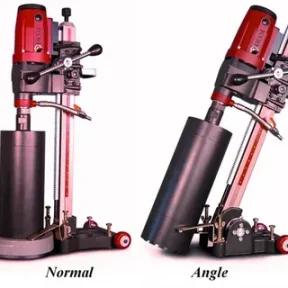
Angled Core Drilling (Bevel Drilling)
Diamond core drilling allows these angled holes to be made with great precision, minimal vibration and low noise. It is often used in concrete, stone or masonry to install pipes, cables or ventilation in a specific direction.
Here are the main reasons for angled core drilling:
- Installation optimization
- Used to ensure that water (in ventilation ducts or drainage pipes) drains away from the structure, avoiding moisture damage
- Accessibility and confined areas
- Geotechnical sampling
- Reducing surface slip on smooth surfaces such as tiles or polished stone
- Sometimes to avoid hitting rebar or other structural elements inside the concrete
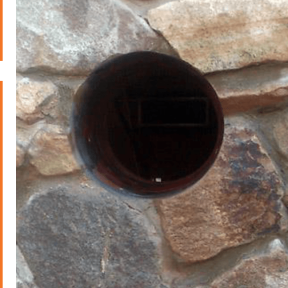
Core drilling in stone walls
The method is used when conventional hammer drills are not precise enough or too small.
Typical applications:
Ventilation: Holes for exhaust or fresh air vents.
Plumbing: Passage of drain pipes and water pipes.
Electrical: Cable routing for electricity and fiber.
Sampling: Extraction of cylindrical samples of stone for strength testing
The main reasons for choosing core drilling are:
- to create extremely precise, round holes
- no risk of cracking the entire wall, as is often done with a hammer drill or chisel hammer
- minimum dust and noise, and the method is generally quieter than impact drilling
- precision and accuracy
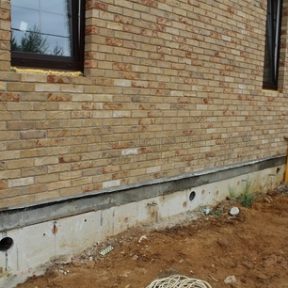
Core drilling in foundations (concrete)
Benefits of core drilling:
Minimal noise and vibration: Gentle on surrounding structures.
Clean process: Provides clean, precise cuts.
Flexibility: Can drill through thick concrete and rebar.
The most common reasons for core drilling in foundations are:
- Installation of pipe penetrations (water, sewage), ventilation ducts, cables and sprinkler systems
- To examine quality, compressive strength, reinforcement corrosion or chloride/carbonation penetration
- To install new reinforcement bars or to inject stabilizing materials (such as epoxy or polyurethane) into the foundation
- when larger or irregular openings are required, a series of overlapping holes are drilled to remove larger sections of concrete
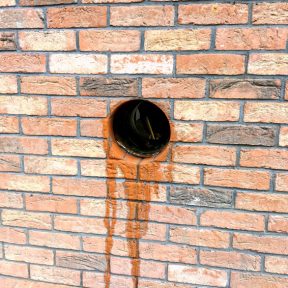
Coring in brick
Coring uses a hollow drill cylinder (core drill) with diamond segments that rotate and cut through the material, rather than crushing through it. The method was chosen because it produces clean cuts without damaging the surrounding structure, compared to chiseling or using a hammer drill.
Typical applications:
- Installation of ventilation (exhaust)
- Pipe penetrations for plumbing
- Cable penetrations for electrical installations
- Masonry sampling for strength and composition analysis
The main reasons for core drilling in brick are:
- precision and accuracy
- minimal damage to the environment
- handles large diameters
- cleaner process
- method can be used vertically, horizontally or at an angle
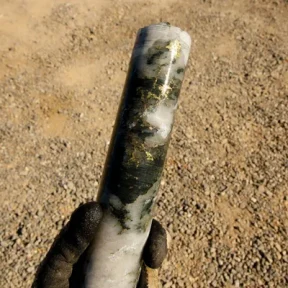
Core sampling (Geological survey)
Diamond drilling allows intact rock samples to be extracted. Diamond drilling cuts through the rock rather than crushing it, which offers advantages in both civil engineering and geological survey. Compared to conventional drilling, diamond drilling is often more expensive, but is superior when precision and undisturbed samples are required.
Here are the main reasons why diamond drilling is used in rock:
- used to investigate mineral and metal deposits
- the method allows samples to be obtained from great depths, often thousands of meters down into the bedrock
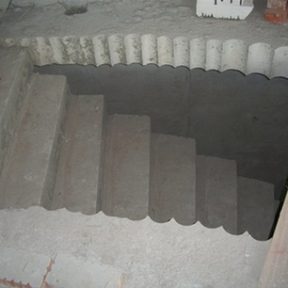
Creating Stair Openings (Stairwells) in Concrete Structures
In projects involving the creation of stairs between floors, especially in basements, core drilling is the preferred method to ensure that the opening is exactly as planned, without damaging the rest of the building.
Here are the main reasons to use core drilling for stair openings:
- handles reinforced concrete
- can be performed both horizontally, vertically and at angles, making it ideal for stairwells in decks
- clean cuts and less cleanup: since the method does not create large vibrations, the risk of structural weakening of the foundation or floor separation is reduced
- minimal vibration and noise
- precision and accuracy