


Demolition
Frequently ordered types of demolition in Bergen and the surrounding area
Demolition of concrete structures is a necessary process in the construction industry, primarily to remove outdated, damaged or unwanted structures to make way for new development. Although concrete is a durable material, it often has to be demolished when maintenance is no longer economically or technically viable.
Important considerations before demolition:
Load-bearing wall: It is crucial to examine whether the wall is load-bearing. Demolition of a load-bearing wall requires an application to the municipality, a building permit and design by professionals.
Application requirement: Removal of concrete walls, especially in basements or load-bearing structures, often requires an application to the municipality and should be assessed by a structural engineer to avoid serious damage to the structure of the house. Although lightweight walls can be demolished without an application, load-bearing structures or changes that affect fire compartments must be applied for.
Professionals: Water and electricity should always be handled by professionals, especially when removing kitchen walls.
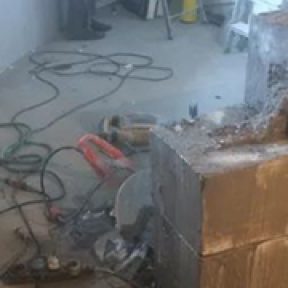
Demolition of walls
Quite often, private individuals contact us for the removal of walls. Demolition of concrete walls requires planning and the right equipment (pickaxe, concrete saw). The use of heavy machinery can cause vibration damage to the building structure.
Private individuals demolish walls in their homes primarily to:
- change the floor plan
- create a more open feeling of space
- increase the quality of life
- increase the value of the home
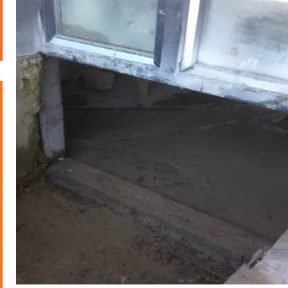
Removing concrete blocks under windows (often called parapets)
The growth from a window is usually distributed to the sides, so the wall section itself under a window is rarely load-bearing in a block wall. Nevertheless, one should always check whether there is reinforcement or structural features before removing concrete.
Concrete blocks under windows are removed mainly to:
- change the size of the window opening
- improve lighting conditions
- replace damaged concrete
- install an escape route
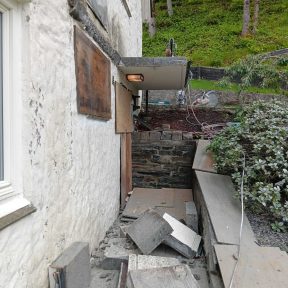
Demolition of concrete slabs
Concrete slabs, especially older ones, can over time become a burden rather than an advantage on the property. In some cases, it may also be more cost-effective to remove a damaged slab and cast a new one, rather than repair an old structure that continues to crack.
Concrete slabs are demolished mainly due to:
- structural damage
- aesthetic upgrade
- poor drainage
- remodeling or renovation
- "concrete cancer" (reinforcement corrosion)
- uneven substrate and safety
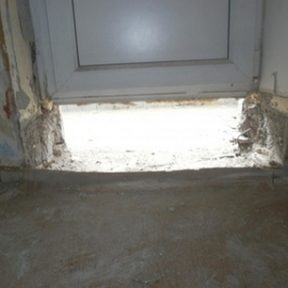
Removing thresholds or exterior walls between the door and the floor
In some cases, older concrete basement exterior walls may have moisture problems, so it is necessary to remove old walls to install new drainage or re-insulate to avoid mold.
There are several main reasons why thresholds or "walls" (threshold/lining) between the door and the floor are removed during renovation:
- structural weakness
- aesthetic upgrade
- remodeling or renovation
- removing moisture damage
- better insulation
- accessibility (Senior Adaptation), especially for wheelchair users, walkers, or those with disabilities
- enlarge door